Categories
Blog

Beyond Printing: Decorative Techniques Used in Hosiery Development

Every season, fashion brands look for new ways to make hosiery stand out.

Sometimes it’s through innovative yarns.

Sometimes it’s through color.

Sometimes it’s the knitting construction itself.

But increasingly, differentiation comes from something much simpler:

Surface decoration.

A well-chosen embellishment can completely transform the personality of a stocking—from elegant and understated to bold and eye-catching.

However, there is no single “best” decorative technique.

Each creates a different visual effect, offers different production characteristics and is suited to different collections.

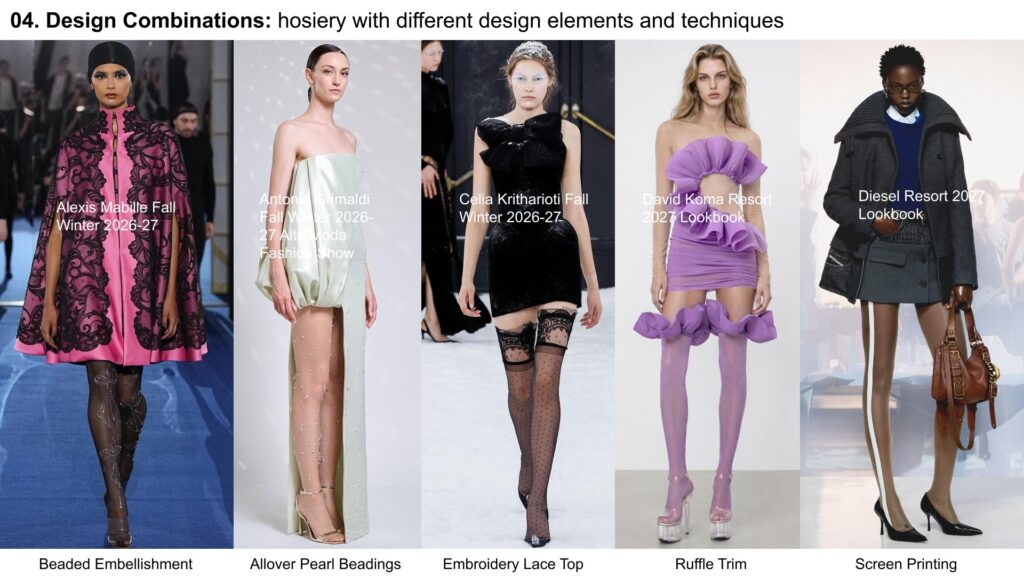
Here’s a practical overview of some of the decorative techniques we commonly use in hosiery development.

Metallic Foil

Gold and silver foils remain some of the most effective ways to create an immediate premium appearance.

Article content
Article content

Unlike metallic yarns, foil creates a smooth reflective surface that catches light dramatically, making it particularly popular for eveningwear, festive collections and fashion-forward statement pieces.

Best suited for

  • Evening collections
  • Holiday capsules
  • Luxury fashion hosiery

Development consideration

Foil artwork should always be designed with the product’s stretch in mind to maintain a clean metallic appearance during wear.

Rhinestones & Pearls

When brands want decoration with real dimension, embellishments such as rhinestones and pearls create an effect that printing simply cannot achieve.

Article content
Article content

These details immediately increase the perceived value of the product while adding depth and texture.

They’re widely used in bridal collections, occasion wear and premium fashion hosiery.

Best suited for

  • Bridal
  • Occasion wear
  • Premium collections

Development consideration

Placement is critical. Decorative elements should avoid areas experiencing excessive extension during wear to maximise durability.

Embroidered Floral Appliqué

This technique combines embroidery craftsmanship with hosiery decoration.

Article content

Instead of embroidering directly onto the stocking, individual floral elements are first created through embroidery and then carefully applied onto the hosiery surface.

The result is a three-dimensional floral effect that brings a unique handmade feel and visual depth to the product.

Best suited for

  • Feminine fashion collections
  • Romantic hosiery designs
  • Premium boutique styles

Development consideration

Because the embroidered flowers are attached onto the surface, the interaction between the adhesive and the hosiery fabric is critical.

For ultra-sheer stockings, the adhesive area may become visible through the fabric or affect the appearance.

Therefore, fabric opacity, placement and adhesive selection should all be evaluated carefully during development.

Flocking

Flocking creates one of the most distinctive tactile experiences available for hosiery.

Article content

Its soft, velvet-like texture creates a beautiful contrast against sheer fabrics, adding both visual depth and a unique hand feel to the product.

Depending on the artwork, flocking can create different personalities—from elegant and feminine to playful or dramatic.

Best suited for

  • Fashion tights
  • Seasonal collections
  • Texture-driven designs

One interesting application is flocking on lace patterns.

Article content

Instead of creating a completely new artwork, flocking can be applied onto existing lace designs to enhance the original pattern with additional texture and dimension.

This allows designers to transform a traditional lace appearance into something more layered and sophisticated, creating new possibilities without changing the basic lace construction.

Development consideration

Because flocking adds an additional surface layer, pattern scale and placement should always consider the stretching behaviour of hosiery.

The design needs to maintain a consistent appearance when the stocking is stretched during wear.

Decorative Patches & Stickers

Applied patches and decorative stickers offer designers additional freedom, making them ideal for logos, limited editions, collaborations and graphic-led collections.

Article content
Article content

Because these elements are applied after manufacturing, they also allow greater flexibility during product customization.

Best suited for

  • Graphic collections
  • Brand collaborations
  • Limited editions

Development consideration

The application area should always be evaluated to ensure good adhesion without restricting the natural stretch of the stocking.

Sequins

Few embellishments create visual impact as effectively as sequins.

Article content

Their ability to reflect light from multiple angles makes them a popular choice for dancewear, performance costumes, partywear and statement fashion pieces.

Rather than covering large areas, sequins are often used selectively to create highlights and movement.

Best suited for

  • Partywear
  • Performance collections
  • Fashion statements

Development consideration

Weight distribution and attachment methods should always be considered to balance appearance, comfort and durability.

Choosing the Right Technique

Decoration is not simply about making a stocking look more beautiful.

Each embellishment changes the product in a different way.

Some techniques maximize visual impact.

Some introduce texture.

Some communicate luxury.

Others help create a stronger brand identity.

For product developers, selecting the right decorative technique is just as important as selecting the right yarn, knitting construction or finishing process.

The best results rarely come from choosing the most eye-catching decoration.

They come from choosing the technique that best supports the story the product is trying to tell.

Categories
Blog

Why Flat Measurements Can Be Misleading in Hosiery

One of the most common questions we hear from brands introducing hosiery for the first time is:

“Can we monitor the product using flat measurements?”

The answer is yes.

But there’s a more important question.

Should flat measurements be the primary way to evaluate a stocking?

In many cases, the answer is no.

Not because flat measurements are unimportant—but because hosiery behaves fundamentally differently from most apparel.

Flat Measurements Work Extremely Well for Apparel

For most woven garments and many cut-and-sew knit products, flat measurements are an effective quality control tool.

Article content

Although these fabrics may have some degree of stretch, the finished dimensions are primarily determined by the garment pattern. When the finished garment matches the intended pattern dimensions, it is generally expected to deliver the designed fit and silhouette.

Because of this close relationship between pattern dimensions and finished measurements, monitoring flat measurements is an effective way to verify production consistency.

Hosiery Behaves Very Differently

Stockings are engineered to stretch and recover.

Their purpose is not to maintain a fixed shape on a table.

Their purpose is to conform comfortably to the wearer’s leg.

At the same time, the materials used in hosiery—primarily nylon and elastane—naturally change dimension as they respond to heat, moisture and the release of knitting tension throughout production.

One of the biggest differences lies in everything that happens before dyeing.

During this stage, the stocking exists only as a greige product.

Fresh off the knitting machine, the greige stocking is still in a loose, unfinished state rather than a stable, well-defined form.

Article content

Before it can be dyed, it still needs to go through several manufacturing processes, including relaxation, toe closing, gusset attaching, panty joining and preparation for dyeing.

At this stage, there is simply no fixed flat dimension that can meaningfully represent the product’s final size.

That’s why monitoring flat measurements before dyeing provides little practical value. The product has not yet reached its final dimensional state.

The Finished Dimensions Are Established During Boarding

The final flat dimensions of a stocking are established during the boarding process.

During boarding, each stocking is stretched over a boarding form under carefully controlled heat.

Article content

Only after this process does the product achieve its final appearance and resting dimensions.

Article content

The dimensions of the boarding form largely determine the stocking’s final flat measurements.

Once the Fit Is Approved, Production Monitors Stretch

If flat measurements aren’t the primary reference, how is size actually controlled?

In hosiery development, the process usually begins with wear trials.

Brands evaluate development samples on real wearers and approve the fit based on actual wearing performance—not on flat measurements.

Article content

Once the fit has been approved through wear trials, the approved sample is measured on the stretch device. Stretch dimensions are recorded at multiple checkpoints, creating the production specification for that style.

Rather than relying on relaxed flat measurements, these stretch specifications become the primary reference for production and quality control, ensuring that every production lot reproduces the approved fit consistently.

Different checkpoints throughout production verify that the stocking reaches the required dimensions under a defined extension, ensuring every production lot consistently reproduces the approved fit.

Article content

Today, one of the most widely used systems for this purpose is the CETME stretch measuring device.

Rather than measuring the stocking in its relaxed state, CETME evaluates the product under a specified stretching force, providing a much more meaningful reference for hosiery size consistency.

Article content

The CETME system also provides a practical demonstration of why flat measurements alone can be misleading.

Consider the two stockings below.

When laid flat, they appear to have almost identical leg lengths.

Based on flat measurements alone, it would be reasonable to assume that they are the same size.

Article content

However, once both stockings are evaluated on the CETME system under the specified stretching force, the difference becomes immediately apparent.

One stocking measures a leg stretch of 265.2 cm, while the other measures 250.3 cm—a difference of nearly 15 cm, despite appearing almost identical when laid flat.

Article content

This illustrates an important principle in hosiery development.

Two stockings may appear to be the same size when laid flat, yet reveal significant differences once measured under controlled stretch.

Flat measurements describe how a stocking rests. Stretch measurements describe how it performs.

That’s why stretch measurements—not flat measurements—are the primary reference for evaluating fit consistency in hosiery production.

But Flat Measurements Still Matter

None of this means flat measurements should be ignored.

They remain extremely valuable in the right situations.

One good example is printed hosiery.

Printing is carried out while the stocking is laid flat.

If the flat dimensions vary too much, the print placement moves accordingly.

The result is inconsistent graphics from one pair to the next.

Article content

Another example is leg-to-leg consistency in pantyhose.

Even if both legs stretch to exactly the same wearable length, a noticeable difference in flat length creates a poor visual impression.

Consumers immediately notice when one leg appears longer than the other—even if the product fits perfectly once worn.

Article content

For this reason, we closely monitor the flat length difference between the two legs during production. Our internal tolerance is typically within 1 cm to ensure a consistent retail appearance while maintaining the intended fit. The example below meets our internal tolerance. Visually, both legs appear well balanced, which is exactly the presentation we aim to achieve at retail.

Article content

Flat measurements still matter.

The key is understanding when they matter—and what they are actually telling us.

Measuring the Right Thing

Flat measurements are an excellent quality control tool.

But like every measurement, they answer a specific question.

The challenge comes when we expect them to answer every question.

In apparel, flat measurements are often a reliable predictor of fit.

In hosiery, they are only one part of a much larger picture that also includes stretch, recovery, boarding conditions, manufacturing consistency and, most importantly, real-world wear.

After all, consumers never experience stockings lying flat on an inspection table.

They experience them on their legs.

The purpose of measurement isn’t simply to collect numbers.

It’s to ensure that every wearer experiences the intended fit.

Categories
Blog

Why Flat Measurements Can Be Misleading in Hosiery Development

One of the most common questions we hear from brands introducing hosiery for the first time is:

“Can we monitor the product using flat measurements?”

The answer is yes.

But there’s a more important question.

Should flat measurements be the primary way to evaluate a stocking?

In many cases, the answer is no.

Not because flat measurements are unimportant—but because hosiery behaves fundamentally differently from most apparel.

Flat Measurements Work Extremely Well for Apparel

For most woven garments and many cut-and-sew knit products, flat measurements are an effective quality control tool.

Although these fabrics may have some degree of stretch, the finished dimensions are primarily determined by the garment pattern. When the finished garment matches the intended pattern dimensions, it is generally expected to deliver the designed fit and silhouette.

Article content

Because of this close relationship between pattern dimensions and finished measurements, monitoring flat measurements is an effective way to verify production consistency.

Hosiery Behaves Very Differently

Stockings are engineered to stretch and recover.

Their purpose is not to maintain a fixed shape on a table.

Their purpose is to conform comfortably to the wearer’s leg.

One of the biggest differences lies in everything that happens before dyeing.

During this stage, the product exists only as a greige stocking.

Fresh off the knitting machine, the greige stocking is still in a loose, unfinished state rather than a stable, well-defined form.

Article content

Before it can be dyed, it still needs to go through several manufacturing processes, including relaxation, toe closing, gusset attaching, panty joining and preparation for dyeing.

At this stage, there is simply no fixed flat dimension that can meaningfully represent the product’s final size.

That’s why monitoring flat measurements before dyeing provides little practical value. The product has not yet reached its final dimensional state.

The Finished Dimensions Are Established During Boarding

The final flat dimensions of a stocking are established during the boarding process.

During boarding, each stocking is stretched over a boarding form under carefully controlled heat.

Article content

Only after this process does the product achieve its final appearance and resting dimensions.

Article content

The dimensions of the boarding form largely determine the stocking’s final flat measurements.

Once the Fit Is Approved, Stretch Becomes the Specification

If flat measurements aren’t the primary reference, how is size actually controlled?

In hosiery development, the process begins with wear trials.

Brands evaluate development samples on real wearers and approve the fit based on actual wearing performance—not on flat measurements.

Once the fit has been approved, the approved sample is measured on the CETME stretch measuring system.

Stretch dimensions are recorded at multiple control points and become the production specification for that style.

From that point onward, production and quality control monitor the product against these approved stretch dimensions—not against its relaxed flat measurements.

Article content

Today, the CETME system is one of the most widely used methods for measuring hosiery under controlled stretch.

Rather than measuring the stocking in its relaxed state, CETME evaluates the product under a specified stretching force, providing a much more meaningful reference for hosiery size consistency.

Article content

The CETME system also provides a practical demonstration of why flat measurements alone can be misleading.

Consider the two stockings below.

When laid flat, they appear to have almost identical leg lengths.

Based on flat measurements alone, it would be reasonable to assume that they are the same size.

Article content

However, once both stockings are measured on the CETME system, the difference becomes immediately apparent.

One stocking records a leg stretch of 265.2 cm, while the other measures 250.3 cm—a difference of nearly 15 cm, despite appearing almost identical when laid flat.

Article content

This illustrates an important principle in hosiery development.

Two stockings may appear to be the same size when laid flat, yet reveal significant differences once measured under controlled stretch.

Flat measurements describe how a stocking rests. Stretch measurements describe how it performs.

For this reason, stretch measurements—not flat measurements—become the primary production reference after fit approval.

But Flat Measurements Still Matter

None of this means flat measurements should be ignored.

They remain extremely valuable in the right situations.

One good example is printed hosiery.

Printing is carried out while the stocking is laid flat.

If the flat dimensions vary too much, the print placement moves accordingly.

The result is inconsistent graphics from one pair to the next.

Article content

Another example is leg-to-leg consistency in pantyhose.

Even if both legs stretch to exactly the same wearable length, a noticeable difference in flat length creates a poor visual impression.

Consumers immediately notice when one leg appears longer than the other—even if the product fits perfectly once worn.

Article content

For this reason, we closely monitor the flat length difference between the two legs during production. Our internal tolerance is typically within 1 cm to ensure a consistent retail appearance while maintaining the intended fit.

The example below meets our internal tolerance. Visually, both legs appear well balanced, which is exactly the presentation we aim to achieve at retail.

Article content

Flat measurements still matter.

The key is understanding when they matter—and what they are actually telling us.

Measuring the Right Thing

Flat measurements are an excellent quality control tool.

But like every measurement, they answer a specific question.

The challenge comes when we expect them to answer every question.

In apparel, flat measurements are often a reliable predictor of fit.

In hosiery, they are only one part of a much larger picture that also includes stretch, recovery, boarding conditions, manufacturing consistency and, most importantly, real-world wear.

After all, consumers never experience stockings lying flat on an inspection table.

They experience them on their legs.

The purpose of measurement isn’t simply to collect numbers.

It’s to ensure that every wearer experiences the intended fit.

Categories
Blog

Statement Fashion Tights – The Must-Have Street Style Trend From LFW Fall Winter 2026

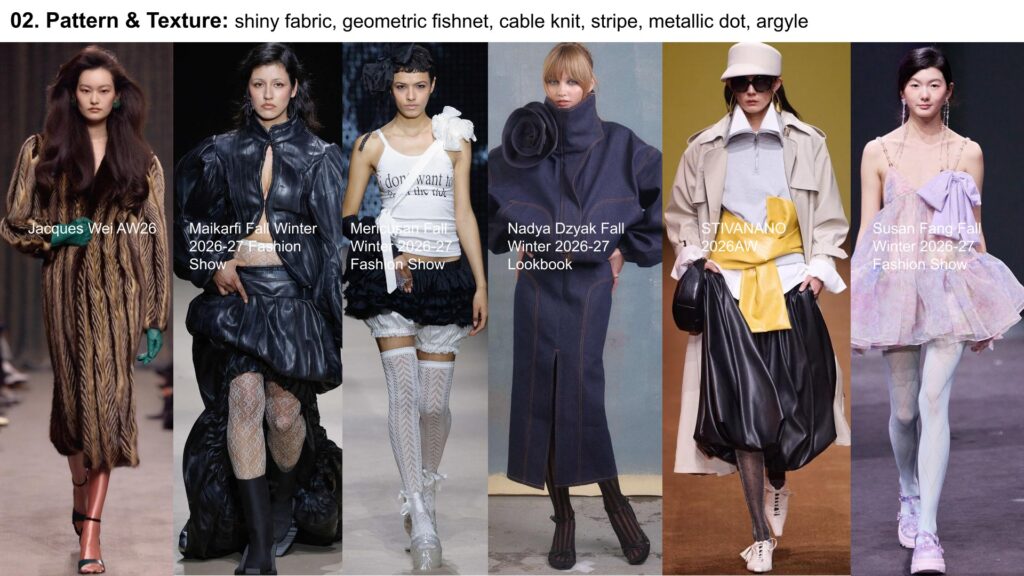
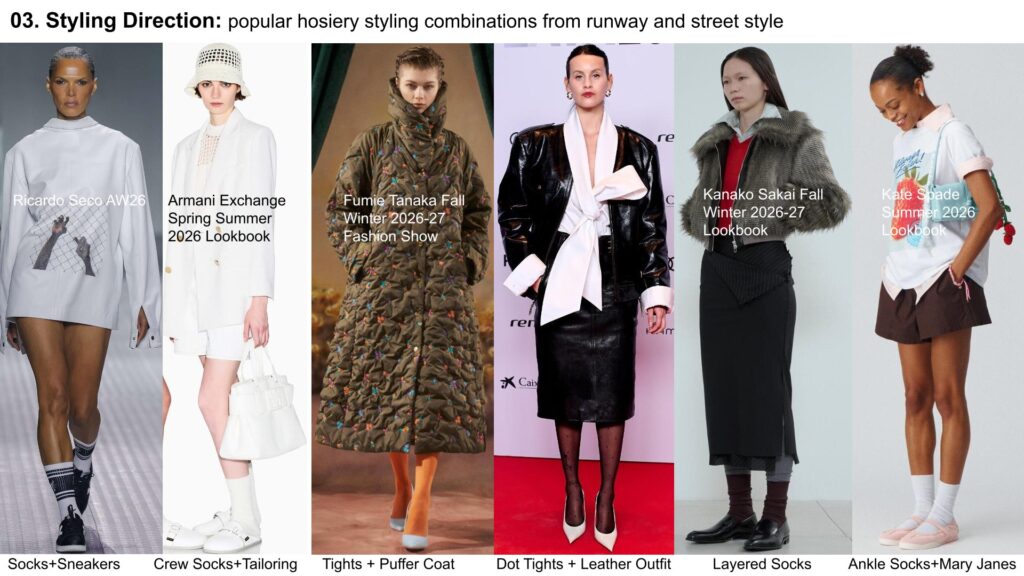
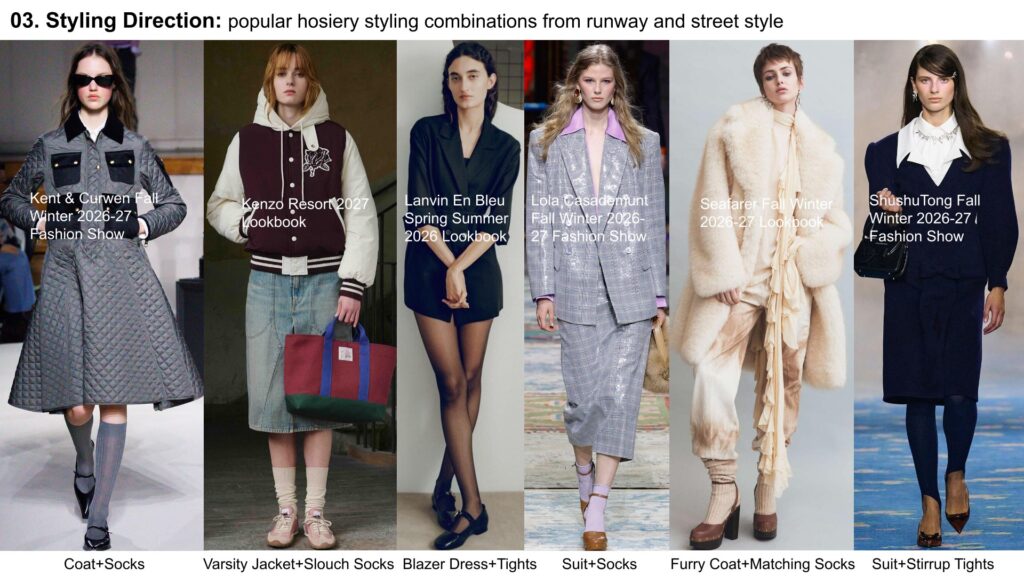
London Fashion Week has unveiled an effortless styling hack to elevate any outfit: statement fashion tights, fondly named “fun tights” by our Coveteur editorial team. These eye-catching hosiery pieces come in countless iterations — vivid solid hues, delicate lace detailing and whimsical distinctive prints. Every corner of London Fashion Week’s Fall/Winter 2026 edition, both runway presentations and street style shots, was covered in them, marking this as a lasting style staple set to dominate the upcoming autumn and winter seasons.

Patterned and pigmented fashion tights first rose to mainstream fame amid the swinging mod era of the 1960s. Paired with flowy mini skirts, they rose to iconic status thanks to trailblazers like Twiggy. What initially served as a bold pop of colour quickly evolved into a powerful style statement: a youthful graphic rebellion against dull neutral wardrobes, and an early sign that personal dressing was all about self-expression rather than conforming to mainstream norms. This perfectly illustrates fashion’s recurring trend cycle. As the quiet luxury bubble fades, maximalist silhouettes and bold colour clashing are making a striking comeback on runways worldwide.

Bora Aksu Fall/Winter 2026 Runway: Lace Tights Craft Romantic Contrast

Bora Aksu’s 2026 autumn-winter collection leaned heavily on frills, lace and sheer tulle, and lace tights amplified the line’s dreamy coquette charm with unexpected styling twists. For instance, creamy white lace tights were matched with a moody charcoal non-traditional bridal ensemble, finished off with a billowy tulle cape and soft veil. These tights were integral to the designer’s narrative, which explored the striking contrast between shadow and light throughout the collection.

Sinead Gorey Fall/Winter 2026 Runway: Rewrite Your Entire Outfit With One Pair of Tights

At Sinead Gorey’s AW26 showcase, playful tights worked harmoniously with outfits while delivering dramatic contrast at the same time. A military-inspired shirt dress with drummer-style trim was styled alongside a vintage Penny Lane coat and classic argyle tights. Elsewhere, a fitted leather mini skirt was layered over a casual baseball tee, paired with a ushanka hat, argyle-patterned tights and sunny yellow heeled sandals.

Further down the catwalk, structured military outerwear was styled with tights decorated with intricate drummer braiding running full-length up the leg, while soft pale blue coats were perfectly coordinated with matching pastel blue tights. Gorey’s collection vividly proves how a single pair of hosiery can fully transform the vibe of any look.

London Street Style: Fashion Enthusiasts Embrace the Fun Tights Trend
Front-row guests and local fashion lovers wholeheartedly embraced this rising hosiery trend, with every style of fashion tights popping up across London’s streets. Animal print variants stole the spotlight as the most sought-after pattern. One standout street look paired zebra-print tights to complement a tailored blazer, while creating a fun clash against a leopard print handbag. Another sleek all-black outfit relied on tiger patterned tights as its bold focal point.
Rich burgundy, soft lavender and baby blue coloured tights add subtle yet stunning pops of colour, crafting artful colour clashes that feel intentional rather than messy. One unforgettable street styling combo caught our eye: an attendee wore Ashley Williams’ “I Heart Me” printed tights teamed with leopard print ankle boots, a colourful fur-trimmed tweed coat, a striped neck tie, textured patterned knitwear and a long strand of pearl beads. Maximalist fashion is officially back in full swing.

Still not convinced how versatile these fun statement tights truly are? Scroll down to browse our curated edit of top-loved styles for your wardrobe rotation.

Categories
Blog

Women’s Sheer Nylon Ankle Stockings | Lightweight Transparent Hosiery

Designed for women seeking a polished and refined appearance, these sheer ankle stockings offer a barely-there feel with exceptional comfort. The ultra-light fabric allows natural breathability while maintaining a smooth and elegant look throughout the day.

The fine-knit construction gently conforms to the foot without restricting movement. A soft elastic cuff helps keep the socks securely in place, making them ideal for office wear, formal occasions, and everyday footwear.

Available in classic nude and black shades, these transparent ankle stockings are a versatile addition to any hosiery collection. OEM and private-label services are welcomed for fashion brands and retailers worldwide.

Categories
Blog

Sparkle Sheer Tights | Lightweight Metallic Pantyhose for Fashion Collections

Sparkle Sheer Tights – Lightweight Metallic Elegance for Modern Fashion

Designed for women who appreciate subtle glamour, these sparkle sheer tights feature delicate metallic fibers woven throughout a lightweight hosiery base. The refined shimmer creates an elegant glow that enhances the appearance of the legs while maintaining a sophisticated and wearable look.

Engineered with a soft stretch fit, these metallic pantyhose provide excellent comfort and flexibility from waist to toe. The sheer construction allows the skin to show through naturally, while the sparkling finish adds depth and dimension to any outfit.

Perfect for fashion-forward collections, evening styling, seasonal launches, and special occasion wear, these glitter tights combine modern design with everyday comfort. Their versatile appearance makes them an excellent addition to premium hosiery and private label product ranges.

Categories
Blog

Seamless Denim Effect Tights | Stretch Fashion Leggings for Women

Upgrade everyday styling with our denim effect tights, engineered to deliver the sleek appearance of fitted jeans with the flexibility of premium hosiery. The finely textured knit creates a realistic denim finish, while the seamless construction ensures superior comfort and freedom of movement.

These versatile women’s leggings tights offer a flattering fit, lightweight feel, and contemporary fashion appeal, making them an excellent choice for retailers, brands, and private label hosiery collections.

Categories
Blog

Luxury Glossy Satin Tights | Shiny Full-Length Pantyhose

Luxury Glossy Satin Tights

Experience timeless elegance with our Luxury Glossy Satin Tights, designed to create a flawless, luminous look from waist to toe. Crafted from premium stretch hosiery fabric, these shiny tights deliver a smooth second-skin fit while enhancing the natural silhouette of the legs.

Each pair is carefully engineered with a seamless full-length construction, ensuring exceptional comfort, flexibility, and durability. The glossy satin finish reflects light beautifully, creating a sophisticated mirror-like sheen that complements both casual and evening outfits.

Available in multiple colors and customizable specifications, these fashion tights are ideal for hosiery brands, lingerie collections, department stores, and private label programs.

Features

  • Premium glossy satin tights
  • Smooth seamless pantyhose construction
  • Elegant high-shine finish
  • Soft and comfortable stretch fabric
  • Full-length footed design
  • Flattering leg-enhancing effect
  • Multiple colors available
  • OEM & ODM customization service
Categories
Blog

Micro Leopard Pattern Jacquard Tights | Fashion Animal Print Tights

Micro Leopard Pattern Jacquard Tights

Elevate everyday styling with our sophisticated Micro Leopard Pattern Jacquard Tights, designed to combine subtle texture with timeless fashion appeal. Featuring an all-over animal-inspired pattern, these fashion tights create a refined statement while remaining versatile enough for daily wear.

Crafted using advanced knitting technology, the intricate micro leopard design is seamlessly integrated into the fabric, ensuring long-lasting pattern definition and exceptional comfort. The soft stretch construction provides a smooth fit from waist to toe, while the wide comfort waistband offers excellent support throughout the day.

Available in multiple colors and customizable specifications, these patterned tights are ideal for fashion retailers, lingerie brands, department stores, and private label hosiery collections.

Features
Elegant micro leopard pattern jacquard design
Soft and comfortable stretch fabric
Wide waistband for enhanced comfort
Seamless all-over animal print effect
Durable knitted pattern with excellent elasticity
Available in multiple colors and denier options
OEM & ODM customization available
Suitable for fashion, casual, and seasonal collections

Categories
Blog

What Really Happens When a Tight Starts to Run? A microscopic look at why some tights ladder — and others don’t

Almost every wearer of sheer tights has experienced the same moment.

A small snag.

A sharp fingernail.

The corner of a chair.

A tiny damage point appears on the surface.

And within seconds, a ladder begins travelling up the leg.

For decades, the hosiery industry has worked to solve this problem. Today, most consumers are familiar with the concept of “Run Resist” tights, and many brands offer them as part of their collections.

But what actually makes a Run Resist tight different from a regular tight?

To answer that question, we decided to look much closer.

Literally.

What Happens Inside a Regular Tight?

When a regular sheer tight is damaged, the yarn loops that form the knitted structure begin to lose their connection.

As one loop releases, it pulls on the next.

Then the next.

Then the next.

The result is the familiar ladder that can quickly travel across a large area of the garment.

Article content

Under a microscope, this process becomes surprisingly clear.

The damaged area reveals a chain reaction of released loops. Once the structure loses its stability, there is very little to stop the run from continuing.

Article content

Why Doesn’t a Run Resist Tight Behave the Same Way?

Now let’s look at a Run Resist tight.

At first glance, the damage may look similar.

A snag still occurs.

A hole may still appear.

But something important changes.

The damage remains localized.

Instead of spreading across the leg, it stays within a limited area.

Article content

Under magnification, the reason becomes visible.

The loops directly affected by the damage are broken, but the surrounding loops remain locked together. The chain reaction never fully develops.

Article content

So where does that difference come from?

The answer is hidden inside the yarn itself.

The Secret Isn’t Visible From the Outside

Run Resist tights are typically knitted using covered yarns.

From the outside, these yarns look almost identical to those used in many conventional sheer tights.

Article content

Under magnification, both constructions appear remarkably similar.

A central elastane filament sits inside a nylon covering layer.

To the naked eye, there is no obvious clue that one yarn will produce a Run Resist product and the other will not.

Article content

The difference lies inside the elastane core.

Run Resist constructions use a special elastane designed to react under elevated heat conditions.

Before heat treatment, the yarn itself looks almost identical to conventional covered yarn.

The transformation happens later.

The Difference Starts Earlier Than Most People Think

At this point, it’s tempting to assume that Run Resist performance is created entirely during the final heat-setting process.

But an important difference already exists before boarding even begins.

Both yarn types are knitted into greige tights using circular hosiery knitting machines.

Article content

From the outside, the unfinished products look remarkably similar.

Article content

Under magnification, however, a different story emerges.

In a typical sheer tight, the knitted structure is usually formed by a combination of two yarn systems.

Some loops are created by pure nylon yarns.

Others are formed by covered yarns containing elastane.

Under the microscope, these two yarn types can be distinguished quite clearly.

The transparent and cleaner-looking loops are pure nylon.

The loops showing the wrapped filament structure are covered yarns.

Article content

A Run Resist construction often looks very different.

Instead of combining pure nylon loops with covered yarn loops, the structure is predominantly formed using covered yarn throughout the fabric.

Under magnification, almost every loop displays the characteristic wrapped structure of covered yarn.

Article content

This turns out to be an important foundation for what happens later.

Because when the garment enters the high-temperature boarding stage, there are simply far more potential bonding points available throughout the knitted structure.

The heat-setting process may create the bonds.

But the opportunity for those bonds is already designed into the fabric from the very beginning.

The Most Important Step Happens After Knitting

After knitting, both regular tights and Run Resist tights follow a very similar production route.

They are sewn.

They are dyed.

They are boarded.

At first glance, the processes appear nearly identical.

However, one critical difference exists during boarding.

Conventional sheer tights are typically boarded at temperatures intended to smooth and stabilize the fabric.

Run Resist tights require significantly higher temperatures.

And this is where the real transformation occurs.

Article content

Under these elevated temperatures, the special elastane within the covered yarn begins to soften and partially melt.

At the points where neighboring loops touch each other, microscopic bonding points begin to form.

Instead of simply crossing over one another, the yarns become connected.

Thousands of times.

Across the entire garment.

Looking 500 Times Closer

Under higher magnification, these bonding points become visible.

In a Run Resist construction, neighboring yarns show evidence of thermal bonding where the softened elastane has fused at contact points.

Article content

A conventional sheer tight shows no such change.

The yarns simply cross over one another without forming permanent connections.

Article content

This microscopic difference creates a completely different behavior when damage occurs.

In a regular tight, a released loop can continue pulling neighboring loops apart.

In a Run Resist tight, the surrounding bonding points act like thousands of tiny anchors distributed throughout the structure.

A damaged area can still occur.

But the damage struggles to travel beyond the immediate zone.

A Different Way to Think About Run Resistance

Consumers see a tight that doesn’t ladder.

Designers see a product feature.

Developers see a performance claim.

Under the microscope, it’s actually a network of thousands of microscopic bonding points working together to contain damage.

What I find fascinating is that none of this is visible from the outside.

Two tights can look almost identical on a hanger.

The difference only becomes clear after a snag occurs.

Or when you look 500 times closer.

Sometimes the biggest performance differences in hosiery are hidden in places consumers will never see.