Categories
Blog

From Yarn to Hosiery: Where Every Stitch Matters

Quality hosiery starts with the right yarn and precise knitting.​
Before production begins, our team carefully prepares the hosiery knitting machines to ensure stable yarn feeding and consistent tension. Once the machines start running, every yarn is knitted stitch by stitch according to the required specifications.​
Although the knitting process looks simple, consistency depends on the right equipment, precise settings, and experienced workmanship. Every detail matters because it creates the foundation for the finishing processes that follow.​
From the first yarn to the finished product, we focus on precision, consistency, and quality to create tights, stockings, and socks that brands can rely on.​
#HosieryManufacturing #HosieryFactory #HosieryProduction #SockManufacturing #SockFactory #TextileManufacturing #KnittingFactory #HosieryManufacturer #SockManufacturer #TextileIndustry #Tights #Stockings #Socks

Categories
Blog

Tights vs. Socks: Two Hosiery Products, Two Very Different Manufacturing Journeys — Part 1

At first glance, tights and socks may seem like two very different products.
But technically, they belong to the same family:
Hosiery.
And if we look at the overall manufacturing flow, they actually share the same basic stages:
Knitting → Sewing → Dyeing → Boarding → Packing
So where do they begin to differ?
The interesting part is that their manufacturing journeys start separating much earlier than many people might expect.
In this two-part series, we take a closer look at how pantyhose — including both sheer and opaque tights — and everyday socks are made, and where the manufacturing challenges begin to diverge.

Article content

1. Knitting — Same Principle, Very Different Machines

Both tights and socks are produced using circular knitting technology.
But the machines used for the two products are quite different in terms of gauge, needle count and cylinder dimensions.
For fine-gauge tights, high needle-count, small-diameter circular knitting machines are commonly used.
Configurations such as 380, 400 and 432 needles can be found in tights production, with cylinder diameters commonly around 4 to 5 inches, depending on the product and machine configuration. Industry references also document pantyhose production using a 400-needle circular machine.

Article content

Sock knitting machines cover a much wider range of configurations because socks themselves vary significantly in thickness, size, construction and design. Commercial machines can range from 96 needles to around 200 needles or more, with cylinder diameters commonly in the roughly 3.5–5 inch range depending on the machine and product.

Article content

So although both products are knitted using the same basic principle, the machinery is already telling us something important: Same knitting principle. Very different manufacturing requirements.

2. The Color Is Decided at a Different Stage

One of the most interesting differences actually begins before knitting starts.
For many sheer and opaque pantyhose, the main yarn construction is a fine nylon/elastane covered yarn. The tights are knitted in a greige, undyed state and then dyed later in the production process. This is a well-established pantyhose manufacturing route.

Article content

Why does this make sense?
Because for tights, color is usually treated as a final garment attribute.
The same greige construction can potentially be developed into different colorways during the dyeing stage.
For example:

Undyed yarn → Knitting → Greige tights → Dyeing → Final color

This gives manufacturers flexibility to produce different colorways from the same basic knitting construction.

Socks Often Take a Different Route

For socks, particularly products featuring:
• Stripes
• Jacquard patterns
• Logos
• Color blocks
• Multiple color effects
pre-dyed yarn is very common.
In this case, the color is already built into the knitting process.

Pre-dyed yarn → Knitting → Color and pattern established

Article contentArticle contentArticle contentThis approach allows the colors themselves to become part of the knitted structure.
And there is an important distinction here:

Socks are not always made from pre-dyed yarn.

Basic solid-color socks can also be knitted from undyed yarn and dyed afterward. Yarn-dyed construction becomes particularly useful when the design itself depends on precise placement of multiple colors.

So the difference is not really:

“Tights use white yarn, while socks use colored yarn.”

It is more accurately:

Tights more often use dyeing as a final garment-color process, while socks frequently use yarn color as part of the knitted design.


3. Why This Difference Matters to Manufacturing

This seemingly small difference has a much bigger impact on factory operations.
For tights, dyeing is an important downstream capability.
The factory needs to control not only knitting and sewing, but also:
• Dyeing equipment
• Color matching
• Chemical control
• Process consistency
• Water management
• Environmental requirements
In other words, dyeing introduces another technically demanding manufacturing stage.
This is one factor that can increase the entry barrier for tights production.
Socks, meanwhile, can have a wider range of manufacturing routes.
A factory producing basic solid-color socks may use piece dyeing, while a factory specializing in patterned or multi-color socks may rely heavily on pre-dyed yarn.
So the manufacturing barrier depends not simply on whether a product is a sock or a pair of tights, but also on how that product is designed to obtain its final appearance.

4. The Product Shape Is Already Different After Knitting

There is another major difference that becomes immediately visible once knitting is complete.
A pantyhose does not come out of the knitting machine as a finished pair.
It comes out as a single leg with a half-panty section.
The two knitted legs must later go through sewing operations to become one complete pair of pantyhose.

A sock is different.
After knitting, it is already essentially an individual sock shape.
Two individual socks only need to be matched into a pair.
[Insert image – Knitted Socks Before Pairing] This means that even before sewing begins, the two products are already at different stages of structural completion.

A sock is already a sock after knitting. A pantyhose is still only part of a pair.

5. Sewing — Where the Difference Becomes Even More Obvious

For socks, the sewing stage can be relatively straightforward.
The most important operation is generally:

Toe Closing

Once the toe is closed, the basic sock structure is complete.

For pantyhose, however, additional operations are required.
One important step is opening/cutting the panty section of the two knitted legs so that they can subsequently be joined together to form one complete pair.

After that, toe closing and the remaining sewing operations are carried out to complete the greige pantyhose structure.
So once again:

Sock: Knitting → Toe Closing → Individual Sock

Pantyhose: Knitting → Panty Opening/Cutting → Joining → Toe Closing → Complete Greige Pair

Categories
Blog

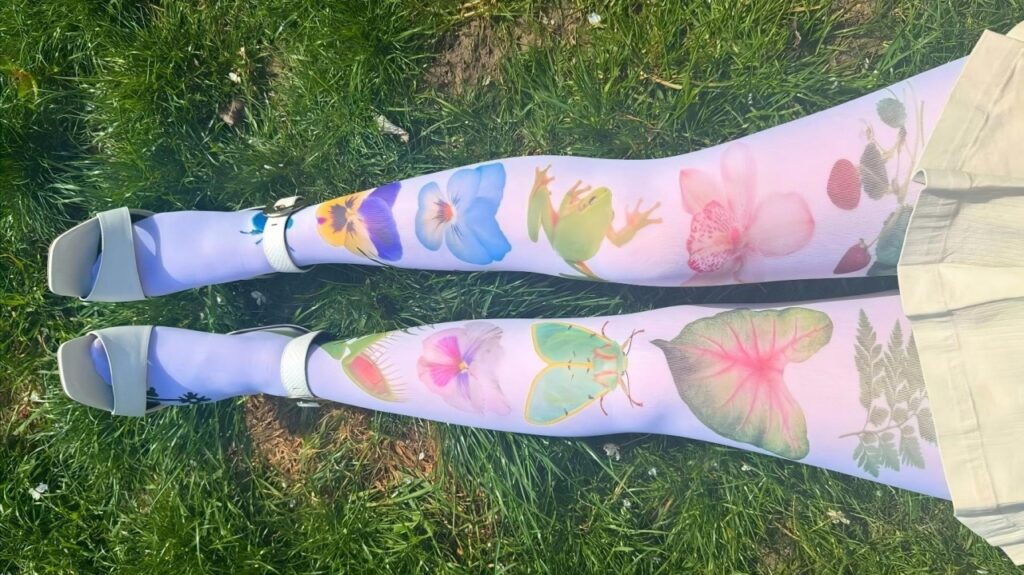
Printed Hosiery: How Different Technologies Shape Design Possibilities and Manufacturing Challenges

In hosiery development, creating eye-catching designs has always been a challenge.
Traditional knitting techniques can create beautiful textures and patterns, but when it comes to complex full-leg graphics, the design possibilities are often limited.
This is where printing technologies create new opportunities.
Today, printed hosiery allows brands to explore:
• Full-leg graphic designs
• Artistic patterns
• Seasonal fashion statements
• Unique visual identities
However, behind every successful printed tights design, there is much more than simply applying a pattern onto fabric.
The real challenge lies in balancing:
Design creativity
with
Material performance and manufacturing control.

Article content

Article content

Article content

Heat Transfer Printing: Turning Artwork into Hosiery Design
One of the most widely used printing methods in hosiery is Heat Transfer Printing.
The basic principle is straightforward:
A pre-designed artwork is first printed onto transfer paper.
Through controlled heat and pressure, the design is then transferred from the paper onto the hosiery surface.
For nylon/spandex hosiery, a typical processing condition is around:
180°C × 20 seconds
The balance between temperature, pressure and time is critical.
If the temperature is too low:
• The transfer may not be complete.
• Color intensity and pattern definition may be affected.
If the temperature is too high:
• The synthetic fibers may be damaged.
• Elastic recovery and wearing performance may decrease

For hosiery, printing is never only about achieving a beautiful appearance.
The process must maintain the original characteristics of tights:
• Stretchability
• Recovery
• Soft hand feel
• Wearing comfort

Material Selection: Why Thickness Matters
Although heat transfer printing provides excellent design freedom, not every hosiery construction is suitable for this process.
Generally speaking, tights below 30D are more challenging for printed designs.
There are two major reasons.
1. Durability Concern
Very thin tights are naturally more delicate.
During heat transfer processing, the combination of:
• Heat
• Pressure
• Mechanical handling
can increase the risk of issues such as:
• Snagging
• Surface damage
• Appearance inconsistency

2. Design Visibility After Wearing
A printed design is created on a relaxed garment.
However, tights are designed to stretch significantly during wear.
When very thin tights are stretched on the body, the artwork may become visually diluted, reducing the intended design impact.

Article content

This is why many successful printed tights designs use slightly heavier constructions.
A suitable fabric balance can provide:
• Better print visibility
• Better durability
• Better consumer experience

Different Printing Technologies for Different Hosiery Structures
When discussing printed hosiery, it is important to distinguish between different printing technologies.
Although both methods can create full-leg designs, Heat Transfer Printing and 360° Printing work in completely different ways.

360° Printing: Similar to Inkjet Printing
Unlike heat transfer printing, 360° printing does not rely on transferring artwork from printed paper.
Instead, the process works more like an inkjet printer.
The machine directly sprays printing ink onto the hosiery surface while the product rotates around the printing system.
This allows continuous printing around the entire circumference of the product.

For shorter hosiery products such as:
• Knee highs
• Ankle highs
• Thigh highs
360° printing can be an effective solution.
These products have a relatively simple tubular structure, allowing the fabric to maintain close contact with the printing system and achieve continuous artwork coverage.

Why Full Tights Are More Challenging for 360° Printing

Categories
Blog

What We Learned from Visiting the Canadian Hosiery Market

This week, the Thriving Team spent time visiting retail stores across Montreal with one simple objective:
To better understand today’s Canadian hosiery market from the retail shelf.
Rather than focusing on individual brands, we wanted to observe broader market trends across different retail channels.
After visiting fashion retailers, department stores, pharmacies, supermarkets and value retailers, several interesting patterns quickly emerged.
Hosiery is no longer a standard category for every fashion retailer.
One of the biggest surprises was how many women’s fashion retailers no longer carry tights.
Instead, shelf space has largely shifted toward cotton socks offered in different lengths, materials and multi-pack options.
Article content
For hosiery product developers, this serves as an important reminder that consumer purchasing habits continue to evolve—and product categories evolve with them.
Where tights remain, functionality comes first.
The broadest hosiery assortments were generally found in pharmacies, department stores and supermarkets rather than fashion boutiques.
Across these channels, product positioning was remarkably consistent.
Instead of emphasizing fashion-driven designs, most products focused on practical everyday performance:
• Sheer
• Opaque
• Control Top
• Support
• Thermal
• Fleece-lined
Article content
From a product development perspective, this suggests that hosiery is increasingly positioned as a functional everyday product rather than simply a fashion accessory.
Similar products often come from very different supply chains.
Another interesting observation came from examining product labels.
Across multiple retail channels, hosiery was sourced from Italy, China, Turkey and Vietnam.
Article content

Article content

Article content
Although many products appeared similar to consumers, the manufacturing origins reflected very different sourcing strategies.
For suppliers, this reinforces an important point.
Retailers are rarely selecting a manufacturing country.
They are selecting the manufacturing capability that best matches each product.
Retail shelves tell the story behind product development.
One of the biggest takeaways from this visit was that retail shelves are much more than product displays.
They are the final result of hundreds of decisions made throughout the entire product development process.
Every product on the shelf has survived multiple rounds of evaluation:
• Does the consumer really need it?
• Does it fit the brand’s positioning?
• Can it be manufactured consistently?
• Does it meet the target retail price?
• Will it generate enough sales to justify its shelf space?
Article content
For product developers, these questions are often far more valuable than simply asking who made the product.
Because by the time a pair of tights reaches a retail shelf, every decision—from material selection and construction to sourcing strategy and merchandising—has already been made.
Understanding those decisions helps us understand not only today’s products, but also where tomorrow’s opportunities may lie.

Categories
Blog

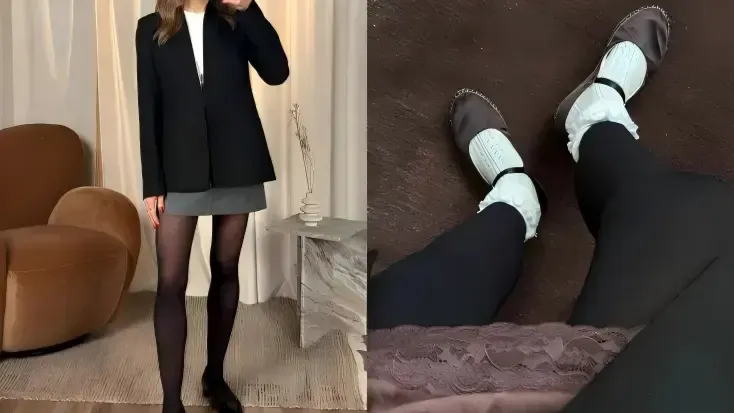
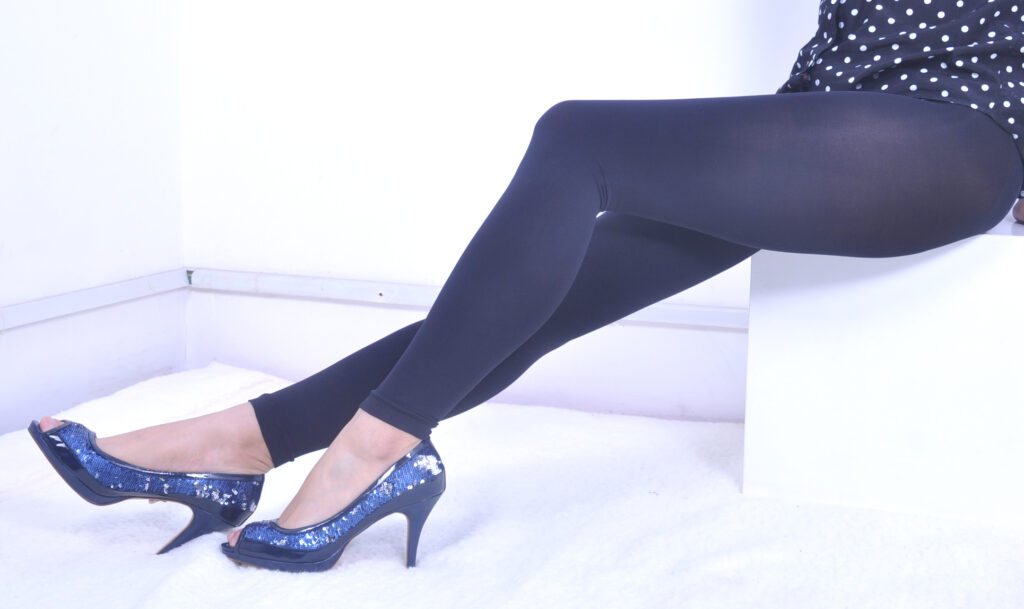
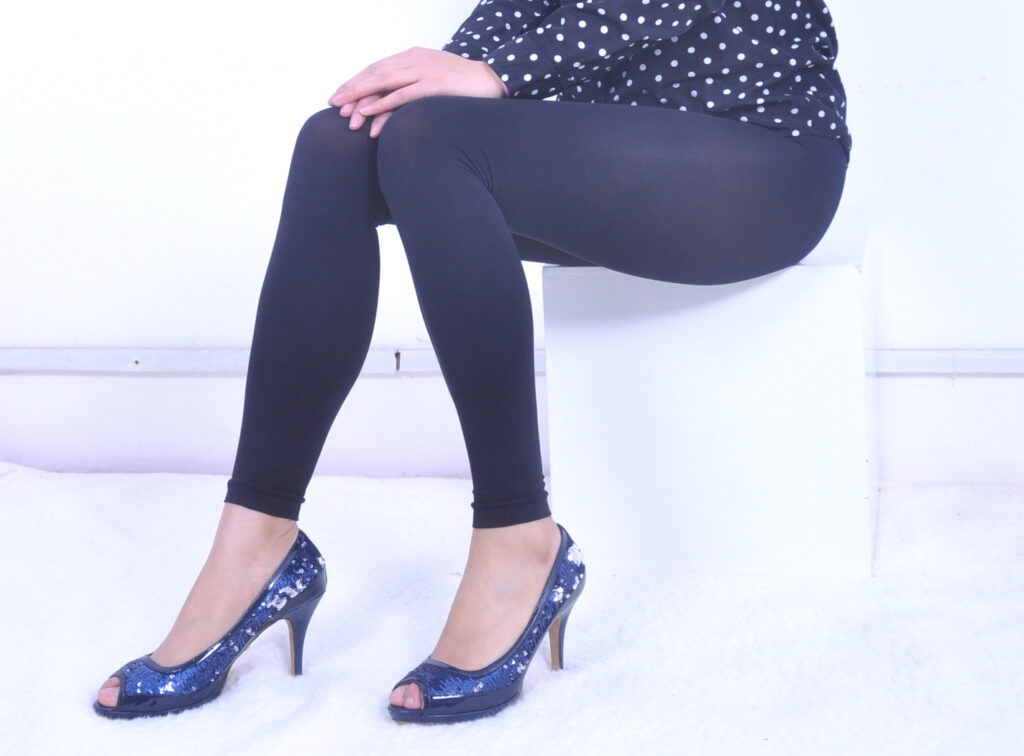
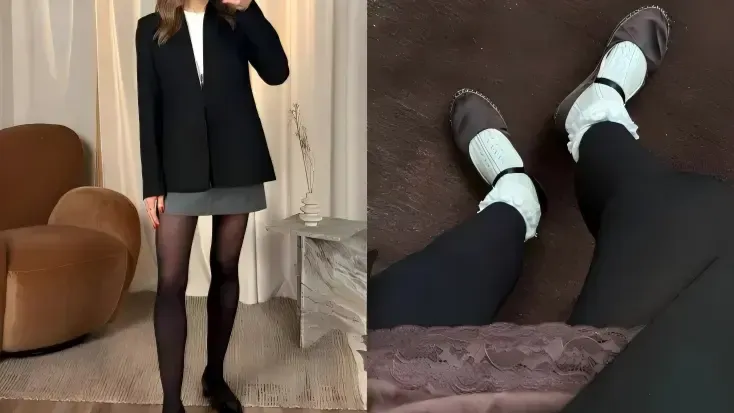
Classic Black Opaque Tights – Elegant Matte Hosiery for Modern Layering Looks

A Timeless Essential for Every Autumn & Winter Wardrobe

Black opaque tights remain a fashion classic, offering the perfect balance between elegance, comfort, and everyday versatility.

Featuring a smooth matte appearance and rich color coverage, these tights create a refined silhouette while adding warmth and style to seasonal outfits. The soft elastic fabric gently embraces the legs, allowing natural movement while maintaining a sleek and polished look.

From office styling to weekend fashion, these versatile hosiery pieces pair effortlessly with dresses, skirts, boots, and oversized knitwear. Their clean finish makes them an essential foundation for creating modern layered outfits.

Designed with comfort and durability in mind, these women’s tights provide a reliable fit throughout the day while keeping a sophisticated appearance.

Product Highlights:

  • Elegant matte black finish with full coverage
  • Soft-touch stretch fabric for comfortable wear
  • Smooth leg shaping effect for a refined look
  • Perfect for autumn and winter fashion collections
  • Suitable for private label and custom hosiery development