
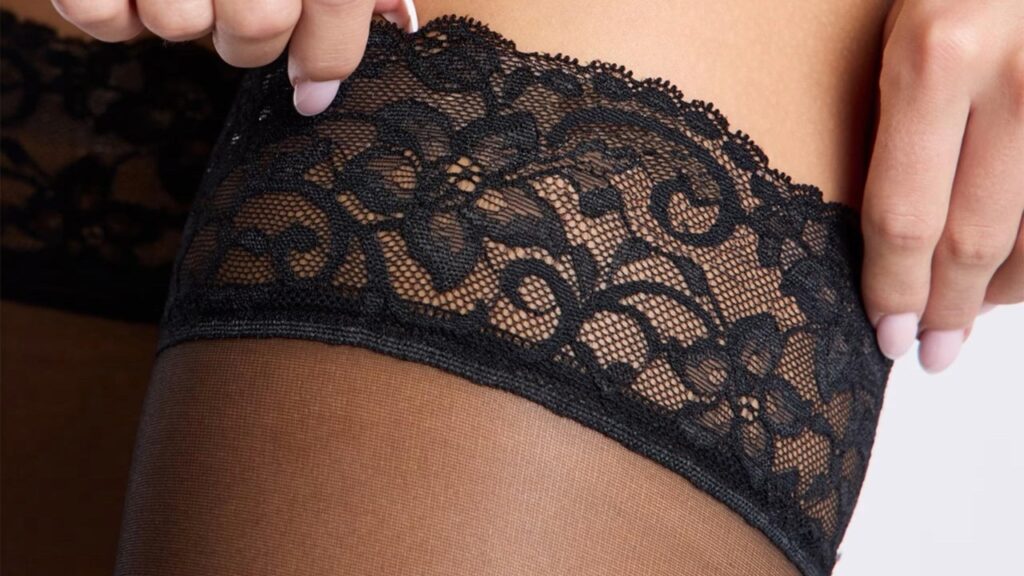
For thigh-high stockings and stay-up stockings, the top construction plays an important role in both appearance and wearing performance. It affects how the product fits around the thigh and, for stay-ups, how securely it remains in place.
Different materials and manufacturing methods offer different possibilities for design, stretch, support, and decoration. In this article, we explore five commonly used stocking top constructions and their characteristics from a hosiery manufacturing perspective.
Before looking at the different options, it is useful to understand the difference between stockings and stay-ups.
Traditional thigh-high stockings do not normally have silicone grips inside the top band. They are designed to be worn with a suspender belt to prevent them from slipping down.
Stay-ups, also known as hold-ups, have a silicone grip inside the top band. This allows them to stay in position on the legs without the need for a suspender belt.
1. Stretch Lace Tops

Stretch lace is one of the most familiar top designs for thigh-high stockings and stay-ups. It combines decorative patterns with elasticity, making it suitable for both classic and fashion-oriented hosiery collections.
This type of lace is commonly produced on elastic Raschel warp-knitting machines. These machines can create intricate lace patterns while incorporating elastic yarns to provide stretch.
However, developing exclusive stretch lace patterns can be more complicated than choosing an existing design. Custom development may require adjustments to machine settings, pattern programming, and yarn preparation.
Depending on the supplier and the design, minimum order quantities for custom stretch lace can reach around 30,000 metres. This can make exclusive lace development challenging for brands looking to start with smaller quantities.
2. Embroidered Lace Tops

For brands looking for more colourful and detailed designs, embroidered lace offers another option.
Unlike knitted stretch lace, embroidered lace is created by stitching decorative patterns onto a mesh base fabric. The design is formed through embroidery rather than directly through the knitting structure of a lace machine.
This process provides greater flexibility in pattern development and colour combinations. It is particularly suitable for floral motifs, decorative details, and multi-colour designs.
Custom embroidered lace orders can often start from around 1,000–2,000 metres, depending on the supplier and design requirements.
There is, however, a difference in performance. Since the mesh base generally has limited elasticity, embroidered lace usually cannot stretch and follow the contours of the thigh as closely as stretch lace.
When selecting this construction, brands need to consider both the visual effect and the required fit.
3. Knitted Plain Tops

Knitted plain tops offer a simple construction and a relatively straightforward manufacturing process.
The stocking leg and top band are knitted directly on a circular hosiery machine. No separate lace or fabric band needs to be attached. After knitting, the product can proceed through the usual dyeing and finishing processes.
Although the construction is simple, this style has also gained attention in recent fashion collections.
Some brands use plain knitted tops to create vintage-inspired stockings. Without elaborate lace decoration, the clean finish gives the product an understated appearance while retaining the character of traditional hosiery.
This construction can be a practical choice for brands looking for a minimal design or a classic stocking look.

4. Woven Elastic Tape Tops

Woven elastic tape is another widely used option for stocking tops, particularly when support and secure fitting are important.
Unlike stretch lace, which is commonly produced on Raschel warp-knitting machines, woven elastic tape is typically manufactured on narrow fabric needle looms. Elastic yarns are incorporated into the woven structure to provide stretch and recovery.
One of its main advantages is its ability to provide firm support around the thigh. The elasticity helps the top band stay in position, making this construction particularly suitable for stay-up stockings.
Woven elastic tape is not limited to basic or plain designs. By combining different yarns and weaving structures, manufacturers can create variations in thickness, texture, and surface appearance.

Stripe Elastic is a good example and a popular option in the market. It demonstrates how an elastic top can serve both a functional and decorative purpose.
With the right combination of materials and construction details, elastic tape can become an important design feature rather than simply a functional component.
5. Cut-and-Sew Plain Fabric Tops

Cut-and-sew fabric tops have become another popular option for stocking development in recent years.
Swimwear fabrics are commonly used for this construction, particularly nylon/elastane blends. These materials offer good stretch and recovery, together with a smooth surface and a subtle sheen.
For brands that prefer a more understated, matte appearance, polyester/elastane fabrics can also be considered. Both options have their own characteristics, and the final choice depends on the intended appearance and overall product design.
Unlike knitted hosiery tops, cut-and-sew construction allows brands to select from a wider range of existing stretch fabrics. This provides more flexibility in colour selection, surface finishes, and visual effects.
It is a useful option for brands that want to explore different fabric appearances without being limited to traditional knitted top constructions.
Final Thoughts
These five constructions are all widely used in the hosiery industry, but each offers different advantages and limitations.
Stretch lace is suitable for decorative designs with good elasticity. Embroidered lace provides more freedom in colours and patterns. Knitted plain tops offer a clean, minimal finish. Woven elastic tape focuses on support and secure fitting, while cut-and-sew fabric tops provide greater flexibility in material selection and appearance.
There is no single construction that works best for every product.
The right choice depends on the designer’s vision, the desired wearing experience, and how the stockings are intended to work with the lingerie or outfit they are paired with.
For hosiery brands, understanding the differences between these constructions is an important step in developing products that balance design, material performance, manufacturing requirements, and everyday wearability.