
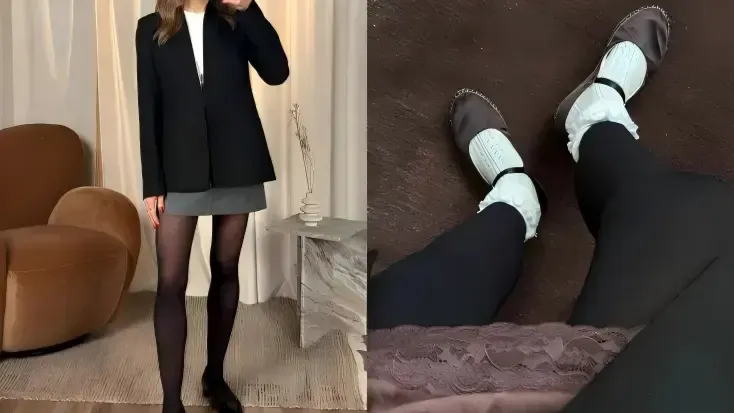
At first glance, tights and socks may seem like two very different products.
But technically, they belong to the same family:
Hosiery.
And if we look at the overall manufacturing flow, they actually share the same basic stages:
Knitting → Sewing → Dyeing → Boarding → Packing
So where do they begin to differ?
The interesting part is that their manufacturing journeys start separating much earlier than many people might expect.
In this two-part series, we take a closer look at how pantyhose — including both sheer and opaque tights — and everyday socks are made, and where the manufacturing challenges begin to diverge.

1. Knitting — Same Principle, Very Different Machines
Both tights and socks are produced using circular knitting technology.
But the machines used for the two products are quite different in terms of gauge, needle count and cylinder dimensions.
For fine-gauge tights, high needle-count, small-diameter circular knitting machines are commonly used.
Configurations such as 380, 400 and 432 needles can be found in tights production, with cylinder diameters commonly around 4 to 5 inches, depending on the product and machine configuration. Industry references also document pantyhose production using a 400-needle circular machine.

Sock knitting machines cover a much wider range of configurations because socks themselves vary significantly in thickness, size, construction and design. Commercial machines can range from 96 needles to around 200 needles or more, with cylinder diameters commonly in the roughly 3.5–5 inch range depending on the machine and product.

So although both products are knitted using the same basic principle, the machinery is already telling us something important: Same knitting principle. Very different manufacturing requirements.
2. The Color Is Decided at a Different Stage
One of the most interesting differences actually begins before knitting starts.
For many sheer and opaque pantyhose, the main yarn construction is a fine nylon/elastane covered yarn. The tights are knitted in a greige, undyed state and then dyed later in the production process. This is a well-established pantyhose manufacturing route.

Why does this make sense?
Because for tights, color is usually treated as a final garment attribute.
The same greige construction can potentially be developed into different colorways during the dyeing stage.
For example:
Undyed yarn → Knitting → Greige tights → Dyeing → Final color
This gives manufacturers flexibility to produce different colorways from the same basic knitting construction.
Socks Often Take a Different Route
For socks, particularly products featuring:
• Stripes
• Jacquard patterns
• Logos
• Color blocks
• Multiple color effects
pre-dyed yarn is very common.
In this case, the color is already built into the knitting process.
Pre-dyed yarn → Knitting → Color and pattern established
 This approach allows the colors themselves to become part of the knitted structure.
And there is an important distinction here:
Socks are not always made from pre-dyed yarn.
Basic solid-color socks can also be knitted from undyed yarn and dyed afterward. Yarn-dyed construction becomes particularly useful when the design itself depends on precise placement of multiple colors.
So the difference is not really:
“Tights use white yarn, while socks use colored yarn.”
It is more accurately:
Tights more often use dyeing as a final garment-color process, while socks frequently use yarn color as part of the knitted design.
3. Why This Difference Matters to Manufacturing
This seemingly small difference has a much bigger impact on factory operations.
For tights, dyeing is an important downstream capability.
The factory needs to control not only knitting and sewing, but also:
• Dyeing equipment
• Color matching
• Chemical control
• Process consistency
• Water management
• Environmental requirements
In other words, dyeing introduces another technically demanding manufacturing stage.
This is one factor that can increase the entry barrier for tights production.
Socks, meanwhile, can have a wider range of manufacturing routes.
A factory producing basic solid-color socks may use piece dyeing, while a factory specializing in patterned or multi-color socks may rely heavily on pre-dyed yarn.
So the manufacturing barrier depends not simply on whether a product is a sock or a pair of tights, but also on how that product is designed to obtain its final appearance.
4. The Product Shape Is Already Different After Knitting
There is another major difference that becomes immediately visible once knitting is complete.
A pantyhose does not come out of the knitting machine as a finished pair.
It comes out as a single leg with a half-panty section.
The two knitted legs must later go through sewing operations to become one complete pair of pantyhose.
A sock is different.
After knitting, it is already essentially an individual sock shape.
Two individual socks only need to be matched into a pair.
[Insert image – Knitted Socks Before Pairing]
This means that even before sewing begins, the two products are already at different stages of structural completion.
A sock is already a sock after knitting. A pantyhose is still only part of a pair.
5. Sewing — Where the Difference Becomes Even More Obvious
For socks, the sewing stage can be relatively straightforward.
The most important operation is generally:
Toe Closing
Once the toe is closed, the basic sock structure is complete.
For pantyhose, however, additional operations are required.
One important step is opening/cutting the panty section of the two knitted legs so that they can subsequently be joined together to form one complete pair.
After that, toe closing and the remaining sewing operations are carried out to complete the greige pantyhose structure.
So once again:
Sock: Knitting → Toe Closing → Individual Sock
Pantyhose: Knitting → Panty Opening/Cutting → Joining → Toe Closing → Complete Greige Pair