
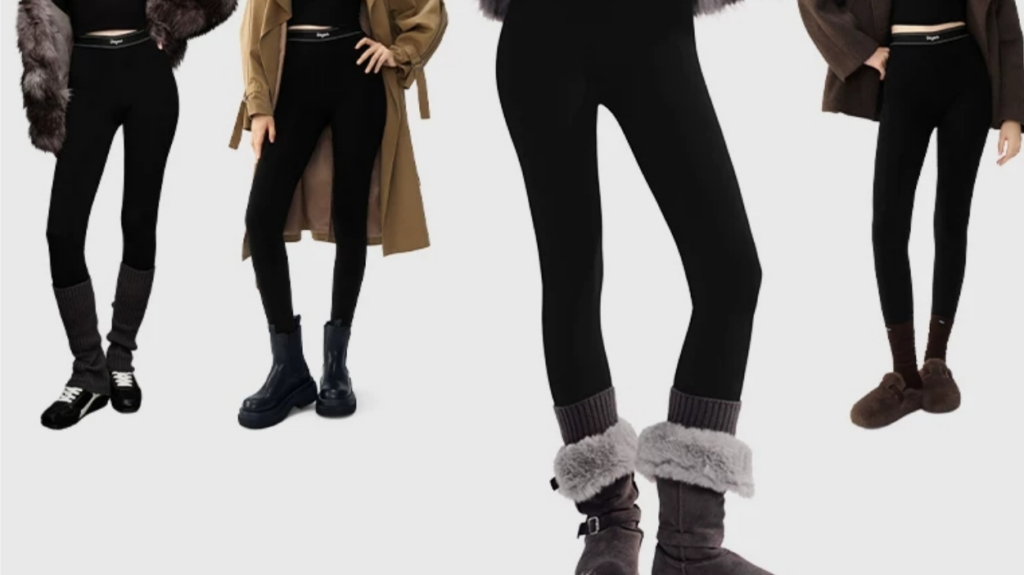
In Part 1, we looked at SIINSIIN — a relatively young Chinese brand using thermal tights to combine warmth with light shaping.
This time, we’re looking at two very different brands:
Xiaoye Hezi (小野和子) and MIIOW (猫人).
Why put these two together?
Because in their Fall/Winter 2026 collections, both have chosen a similar technical starting point — circular-knitted thermal tights.
But what they are trying to achieve with that construction is almost completely different.
Xiaoye Hezi is one of the most visible new-generation Chinese functional apparel brands, best known for turning the “bare-leg look” into a highly developed product category.
MIIOW, on the other hand, has been in the intimate-apparel business since 1998 and has built its identity around technology, comfort and large-scale everyday apparel.
So we thought this would make an interesting comparison.
Same basic knitting platform. Very different product philosophies.
Let’s take a closer look.
Xiaoye Hezi: Making Thermal Tights Look Like Real Legs
Xiaoye Hezi was established in 2021 and has built its reputation around functional women’s apparel, with its “bare-leg tights” becoming one of its best-known products. The brand’s approach is relatively clear:
Make a functional product, but never let the function destroy the appearance.
That is particularly important for skin-tone thermal tights.
The consumer doesn’t simply want warmth.
She wants the tights to look like real skin.
And that makes the product much more demanding than an ordinary pair of thermal tights.


At first glance, the most striking thing about this product is the colour.
The skin tone is unusually rich and lively.
But the more interesting part appears when we turn the tights over.
Different knitting structures are combined across the garment, creating visible changes in texture and construction.
This makes the product feel less like a simple “thermal tight” and more like a deliberately engineered piece of apparel.
1. The Honeycomb Construction

One of the most interesting details is around the abdomen.
The fabric uses a honeycomb-like structure with multiple openings.
There are two things happening here.
First, the structure can increase the tension of the fabric surface and provide a degree of shaping around the abdomen.
Second, the open structure creates additional air spaces, which can help improve breathability compared with a more densely knitted surface.
This is a good example of something we often see in well-developed hosiery:
One knitting structure can be asked to solve more than one problem.
It can contribute to shaping, while also influencing breathability and the visual texture of the garment.
2. The Fibre Choice Is Part of the “Bare-Leg” Effect

The main fibre in this product is nylon, supported by elastane.
That combination makes sense for this particular product concept.
The elastane provides the stretch and recovery needed to keep the tights close to the body.
But nylon is equally important here for another reason.
When nylon is dyed into a carefully developed skin tone, it can produce a very fine, clean surface with a depth of colour.
And that matters enormously for a “bare-leg” product.
The consumer is not only buying warmth.
She is buying the illusion of bare skin.
3. The Quality Control Is Surprisingly Difficult

There is another detail that caught our attention.
As hosiery manufacturers, we know how difficult it is to produce a very light, saturated skin tone consistently.
On a colour this delicate, even a very small contamination point, dye spot or yarn imperfection can become immediately visible.
Yet on the pair we tested, we could not find any obvious visible contamination or colour spots on the surface.
That may sound like a small thing.
It isn’t.
For black tights, a tiny defect can sometimes disappear into the overall appearance.
For a light skin-tone tight, there is nowhere for it to hide.
So the cleanliness of the surface is itself part of the product quality.
MIIOW: When Thermal Tights Start Looking Like Leggings
Now let’s look at the second product.

At first glance, the difference is obvious.
While Xiaoye Hezi is trying to make the tights look more like skin, MIIOW is moving in almost the opposite direction.
This product belongs to the type of Chinese thermal bottoms often described as “cloud pants” — products designed around softness, stretch and a relaxed, almost fabric-like appearance.
And again, the choice of circular knitting is important.
Instead of using the knitting structure primarily to create a tight, body-hugging hosiery silhouette, the construction is designed to create a much more relaxed hand and appearance.
The result looks much closer to a pair of fabric leggings than conventional tights.
1. Stretch Is Used to Create Comfort
A key part of this construction is the combination of a highly stretchable circular-knitted structure with relatively extended boarding dimensions.
The idea is not to make the garment feel tight.
Quite the opposite.
The fabric is allowed to open up and relax, creating a softer, more fluid appearance when worn.
This is also why the waistband is visually different.

Instead of trying to hide the waistband inside the knitted structure, the product uses a separate elastic waistband.
It reinforces the leggings-like appearance and supports the overall relaxed construction.
The technology here is therefore serving a completely different purpose.
For Xiaoye Hezi:
Stretch helps the garment stay close to the body.
For MIIOW:
Stretch helps the garment feel free on the body.
Same basic knitting platform.
Very different product objective.
2. Viscose Changes the Wearing Experience

The fibre composition tells us even more.
The main fibre is viscose.
This is an important choice.
If the product were built primarily around nylon and elastane, it could achieve a much more body-hugging and elastic feel.
But that would work against the “cloud pants” concept.
Viscose brings a different hand feel and allows the garment to have a softer, more relaxed character while maintaining good breathability.
So the fibre choice is not simply about softness.
It is helping the material behave in a way that supports the comfort-first positioning of the product.
One Trend They Both Share: Thin Brushed Thermal Surfaces

Interestingly, despite their very different product directions, both products use a similar thermal solution on the inside:
a relatively thin brushed surface.
We discussed this in Part 1 as well.
The idea is simple.
Instead of making the entire garment substantially thicker, a fine layer of brushed fibres is created on the inside surface to improve warmth.
This is becoming an increasingly common direction in China’s thermal tights market.
The goal is no longer simply:
“Make it thicker, make it warmer.”
It is:
“Create warmth without making the consumer feel bulky.”
Both products are responding to that same consumer expectation — just in very different ways.
Now, Let’s Put Them On
For this round of testing, we used a slightly larger model to explore the upper end of the fit more carefully.
Our model is 168 cm and 60 kg.
This gave us a useful opportunity to see not only how the garments fit, but also how their different construction philosophies behave on a larger body.
Xiaoye Hezi: The Bare-Leg Effect Works

The first impression was very positive.
1. Surprisingly Comfortable
We were particularly interested in the seams.
The waistband and panty area use a seamless knitting construction, with relatively long stitched connections joining the panty area to the legs.
Before trying them on, we wondered whether those long seam areas might create noticeable pressure or discomfort.
They didn’t.
Once worn, the seams were surprisingly difficult to feel.
This is an interesting follow-up to what we found in Part 1 with SIINSIIN.
There, the back-panel seam was one of the areas where we could feel a difference in stretch behaviour.
Here, the construction is much more successful.
It reinforces an important point:
A seam itself is not necessarily the problem.
The real issue is how the seam is constructed, how it stretches, and how its behaviour matches the surrounding fabric.
With the right construction, a seam can almost disappear during wear.
2. The Colour Looks Natural

The skin tone is another strong point.
It has a distinctly matte appearance rather than a shiny, artificial look.
That matters enormously for this category.
The moment a skin-tone tight starts to look glossy, overly yellow or obviously synthetic, the illusion is lost.
Here, the colour and surface work together to create a much more convincing bare-leg appearance.
Looking closely at the surface, the construction also appears consistent with the use of a dyeable elastane approach, where the elastane can take colour alongside the nylon.
Why does that matter?
Because undyed or differently coloured elastane can introduce a slight visual contrast or shine.
Reducing that contrast helps create a more uniform surface.
For a skin-tone tight, even small differences can be surprisingly visible.
3. The Fit Is Very Close to the Leg

The tights also stay very close to the body.
There is very little visible wrinkling around the legs.
That is especially important for this product category.
A black tight can tolerate a certain amount of movement or folding.
A skin-tone tight cannot.
If the fabric starts to bunch around the knee or ankle, the visual illusion immediately breaks.
You suddenly see a pair of tights rather than a pair of legs.
Achieving this kind of fit is not down to one ingredient.
It depends on the interaction between yarn performance, elastane recovery, knitting dimensions and finishing.
And this is where good product development becomes much more than simply choosing a “better yarn.”
MIIOW: Comfort First

The MIIOW product gave us a completely different wearing experience.
And that is exactly what we expected from the construction.
1. Almost Weightless on the Body
The overall comfort is excellent.
There is very little feeling of compression or restriction.
Instead, the fabric has a relaxed, almost weightless character.
In that sense, it achieves the basic objective of the “cloud pants” concept.
You don’t feel like you are wearing a pair of tight tights.
You feel closer to wearing a soft pair of leggings.
2. A Different Kind of Versatility
That relaxed character also changes where the product can be worn.
Because it doesn’t have the tight, hosiery-like appearance of traditional thermal tights, it works better as an outer base layer.
It can sit naturally within an everyday outfit, but it can also be used for activities such as yoga, running or other light exercise.
So while Xiaoye Hezi is optimising the product around appearance, MIIOW is expanding the product’s usability through comfort and versatility.
But there are still a couple of areas where we think the construction could be improved.
What Could Be Improved?
1. The Leg Could Be Slightly Longer
he first issue is the length.
Because viscose does not provide the same level of stretch as a nylon-rich construction, the garment does not have quite as much longitudinal adaptability.
On our 168 cm / 60 kg model, the leg length felt slightly short for a product intended to be worn as leggings.
Adding a little more length could make the product more accommodating across taller or longer-legged consumers.
This is a relatively small adjustment.
But for leggings, length is part of fit — not just a measurement on a spec sheet.
2. The Waistband Transition Could Be Better

The second issue is at the waistband.
The waistband and the panty body are made from two quite different materials.
As a result, their stretch and recovery do not perfectly match.
When worn, this can create some wrinkling where the elastic meets the knitted body.
The solution does not necessarily need to be a stronger elastic.
In fact, a softer elastic with more suitable stretch and recovery may integrate better with the body of the garment.
The goal should be for the waistband and the panty to behave more like one system.
So, What Can We Learn From These Two Products?
This comparison is perhaps more interesting than looking at either product on its own.
Both brands chose circular knitting.
Both used brushed interiors.
Both are trying to create warmth without excessive bulk.
And that is the key lesson.
The knitting machine does not determine the product concept.
The same platform can be pushed in completely different directions.
Xiaoye Hezi uses stretch, fine surface control and colour development to pursue:
a close fit + natural skin appearance + light shaping.
MIIOW uses stretch, viscose and a more relaxed construction to pursue:
softness + freedom of movement + everyday versatility.
Even the fibre choices tell the same story.
Nylon and elastane support a close-fitting, controlled silhouette.
Viscose helps create a softer and more relaxed wearing experience.
And the brushed interior shows that both products are responding to the same larger market trend:
warmth without bulk.
What I find most interesting is that neither product is simply “better” because it uses more technology.
They are solving different problems.
For Xiaoye Hezi, the challenge is:
How do you make thermal tights look convincingly like bare legs?
For MIIOW, the challenge is:
How do you make a thermal garment feel more like comfortable everyday clothing?
And once you look at the products this way, the construction decisions start to make much more sense.
That’s perhaps the most useful thing we can learn from looking at products physically.
Technology is only valuable when it serves a clear wearing experience.
And sometimes, two brands can start with almost the same technical platform — and end up creating two completely different products.