
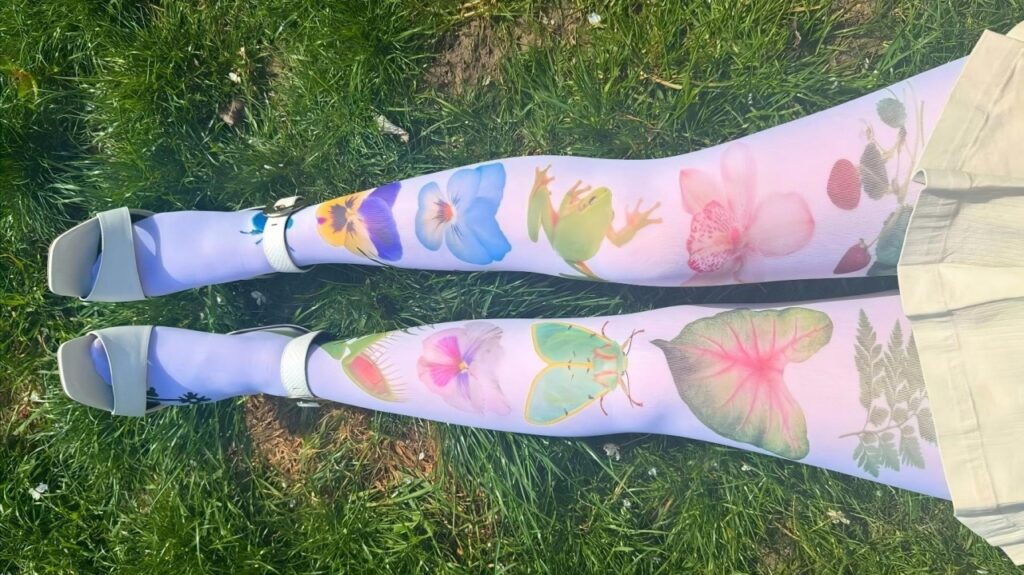
In hosiery development, creating eye-catching designs has always been a challenge.
Traditional knitting techniques can create beautiful textures and patterns, but when it comes to complex full-leg graphics, the design possibilities are often limited.
This is where printing technologies create new opportunities.
Today, printed hosiery allows brands to explore:
• Full-leg graphic designs
• Artistic patterns
• Seasonal fashion statements
• Unique visual identities
However, behind every successful printed tights design, there is much more than simply applying a pattern onto fabric.
The real challenge lies in balancing:
Design creativity
with
Material performance and manufacturing control.


Heat Transfer Printing: Turning Artwork into Hosiery Design
One of the most widely used printing methods in hosiery is Heat Transfer Printing.
The basic principle is straightforward:
A pre-designed artwork is first printed onto transfer paper.
Through controlled heat and pressure, the design is then transferred from the paper onto the hosiery surface.
For nylon/spandex hosiery, a typical processing condition is around:
180°C × 20 seconds
The balance between temperature, pressure and time is critical.
If the temperature is too low:
• The transfer may not be complete.
• Color intensity and pattern definition may be affected.
If the temperature is too high:
• The synthetic fibers may be damaged.
• Elastic recovery and wearing performance may decrease
For hosiery, printing is never only about achieving a beautiful appearance.
The process must maintain the original characteristics of tights:
• Stretchability
• Recovery
• Soft hand feel
• Wearing comfort
Material Selection: Why Thickness Matters
Although heat transfer printing provides excellent design freedom, not every hosiery construction is suitable for this process.
Generally speaking, tights below 30D are more challenging for printed designs.
There are two major reasons.
1. Durability Concern
Very thin tights are naturally more delicate.
During heat transfer processing, the combination of:
• Heat
• Pressure
• Mechanical handling
can increase the risk of issues such as:
• Snagging
• Surface damage
• Appearance inconsistency
2. Design Visibility After Wearing
A printed design is created on a relaxed garment.
However, tights are designed to stretch significantly during wear.
When very thin tights are stretched on the body, the artwork may become visually diluted, reducing the intended design impact.

This is why many successful printed tights designs use slightly heavier constructions.
A suitable fabric balance can provide:
• Better print visibility
• Better durability
• Better consumer experience
Different Printing Technologies for Different Hosiery Structures
When discussing printed hosiery, it is important to distinguish between different printing technologies.
Although both methods can create full-leg designs, Heat Transfer Printing and 360° Printing work in completely different ways.
360° Printing: Similar to Inkjet Printing
Unlike heat transfer printing, 360° printing does not rely on transferring artwork from printed paper.
Instead, the process works more like an inkjet printer.
The machine directly sprays printing ink onto the hosiery surface while the product rotates around the printing system.
This allows continuous printing around the entire circumference of the product.
For shorter hosiery products such as:
• Knee highs
• Ankle highs
• Thigh highs
360° printing can be an effective solution.
These products have a relatively simple tubular structure, allowing the fabric to maintain close contact with the printing system and achieve continuous artwork coverage.
Why Full Tights Are More Challenging for 360° Printing