

Yuhan Wang is a London-based Chinese fashion designer known for her romantic, feminine aesthetic and distinctive use of delicate fabrics, floral prints and lingerie-inspired details.
After studying womenswear at Central Saint Martins, she gained experience at Marni before presenting her collections through Fashion East at London Fashion Week. Her designs often explore the relationship between femininity, softness and sensuality, combining delicate details with unexpected proportions and unconventional styling.
For her Spring Summer 2027 collection, hosiery was more than a finishing accessory. Different styles, textures and construction methods became part of the overall visual expression. Looking at the collection from a hosiery industry perspective, we can identify several distinct product types and explore the techniques behind them.

1. Invisible Socks: When the Product Becomes the Styling
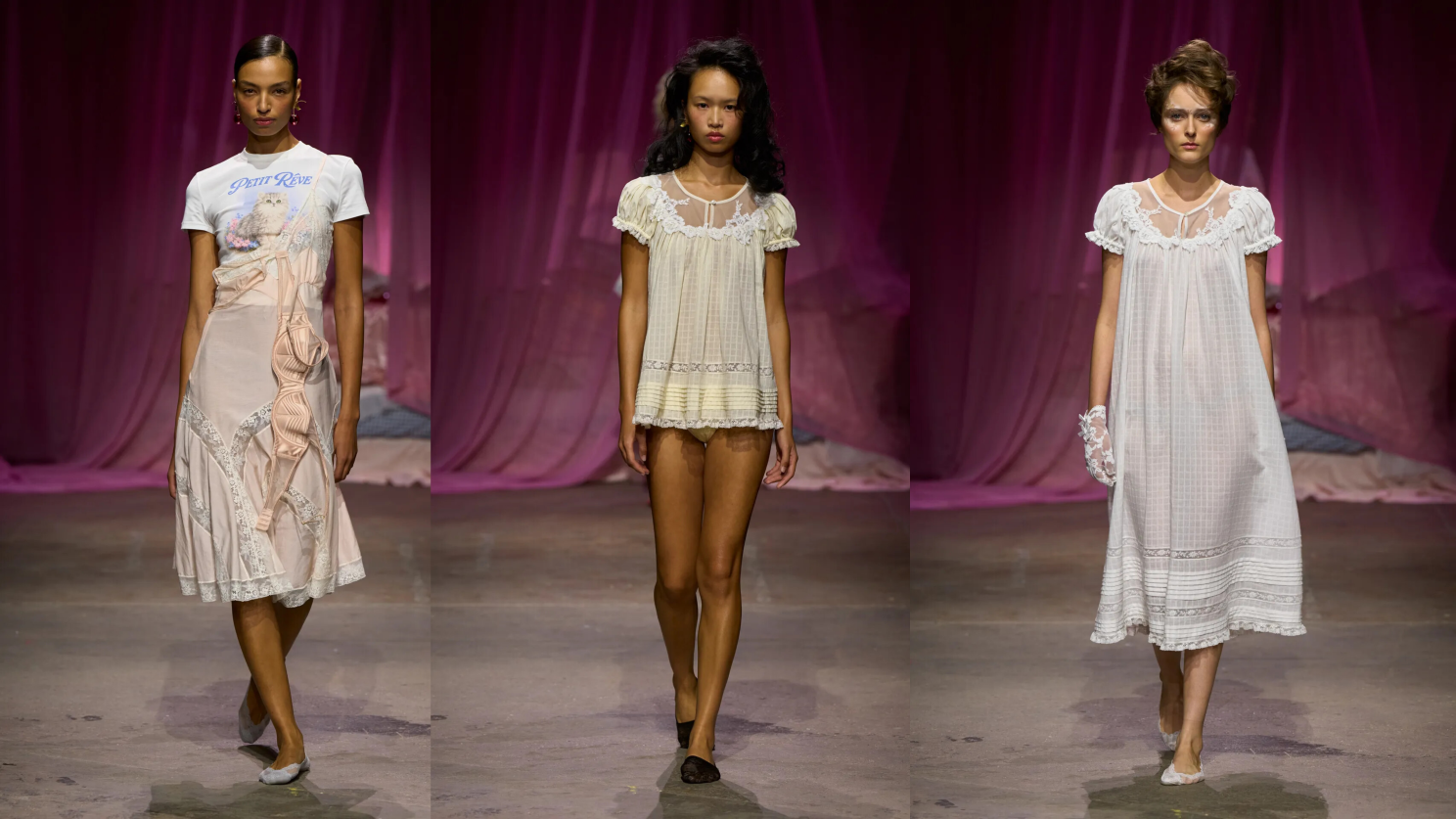
Invisible socks are designed to sit inside shoes, remaining hidden while providing a layer between the foot and the footwear. In this show, however, Yuhan Wang deliberately styled models without shoes, allowing the socks themselves to become visible.
It was a simple but effective way to bring an otherwise discreet product into the spotlight.
From a manufacturing perspective, this type of sock follows a principle familiar to apparel production. Fabric is cut into the required shapes and then sewn together to create the finished product. Unlike traditionally knitted hosiery, the construction relies on cut-and-sew techniques rather than knitting the entire sock directly on a hosiery machine.
The result is a different design language, with more flexibility in fabric selection, shape and finishing details.
2. Fishnet: More Than a Traditional Mesh Pattern

Fishnet is another prominent hosiery element in the collection. Yuhan Wang combines it with colours such as white and mustard yellow, moving beyond the familiar black fishnet tights. The range also extends to socks, bringing greater variety to the styling.

From a technical perspective, fishnet and conventional sheer or opaque tights are generally made using different knitting technologies.
Traditional sheer and opaque tights are typically produced on circular weft-knitting hosiery machines. Fishnet hosiery, by contrast, is commonly made on warp-knitting machines, particularly Raschel machines. These use multiple yarn ends to form interconnected loops, making them suitable for open mesh structures and a wide variety of net patterns.
From a product-development perspective, one area worth exploring further is the design of the mesh itself.
Many of the fishnet styles in the show use familiar floral motifs that are already widely available in the market. But Raschel machines can produce a much broader range of mesh structures and patterned effects.
For example, the floral fishnet tights worn by Taylor Swift from Fleur du Mal show how a more distinctive pattern can give a familiar product a stronger visual identity.

There is still considerable room for brands to explore new patterns, scale, placement and combinations of mesh structures. The opportunity is not necessarily to reinvent fishnet, but to make it more recognisable and ownable through design.
3. Traditional Jacquard Sheer Hosiery: Creating a Lace-Look Effect
The third category is patterned sheer hosiery, featuring floral motifs that create a lace-like appearance. In this collection, the designs mainly use black and white, allowing the patterns themselves to stand out.

These styles are typically produced on circular weft-knitting hosiery machines, using different knitting structures to create the pattern.
One limitation is that the machine’s capabilities and knitting structure can restrict how fine or complex a pattern can be. Not every lace-inspired design can be reproduced easily in knitted hosiery.
This helps explain the growing appeal of cut-and-sew lace tights and leggings, which bring us to the fourth category — and one of the most frequently used hosiery directions in this show.
4. Cut-and-Sew Lace Tights: More Freedom in Design
Compared with conventional knitted tights that imitate the look of lace, cut-and-sew lace tights offer much greater freedom in the choice of fabric, pattern and visual effect.


The principle is essentially an extension of conventional garment-making into hosiery: instead of knitting the complete garment on a hosiery machine, manufacturers cut panels from lace or other sheer fabrics and sew them together to create the finished tights.
This approach opens up many more possibilities for design. Intricate lace patterns, different fabric grounds and distinctive visual textures can be used without being limited by the pattern capabilities of a traditional hosiery machine.
However, there are trade-offs.
Because the garment is cut and sewn, seams are usually present along the inner legs. And unlike knitted tights, which are engineered to stretch closely around the body, cut-and-sew styles may not follow the contours of the legs as precisely. The final fit depends heavily on the fabric’s stretch and recovery, pattern engineering and garment construction.
For designers looking to prioritise visual impact and fabric choice, these compromises may be worthwhile. The key is understanding how the construction affects the wearing experience.

A Final Thought
Yuhan Wang’s Spring Summer 2027 show offers an interesting look at how hosiery can contribute to fashion beyond its traditional role as a basic accessory.
From Invisible Socks and Fishnet to patterned sheer hosiery and Cut-and-Sew Lace Tights, each technique creates different opportunities — and different trade-offs. For hosiery brands, the challenge is to turn these visual ideas into products that work just as well in real life as they do on the runway.